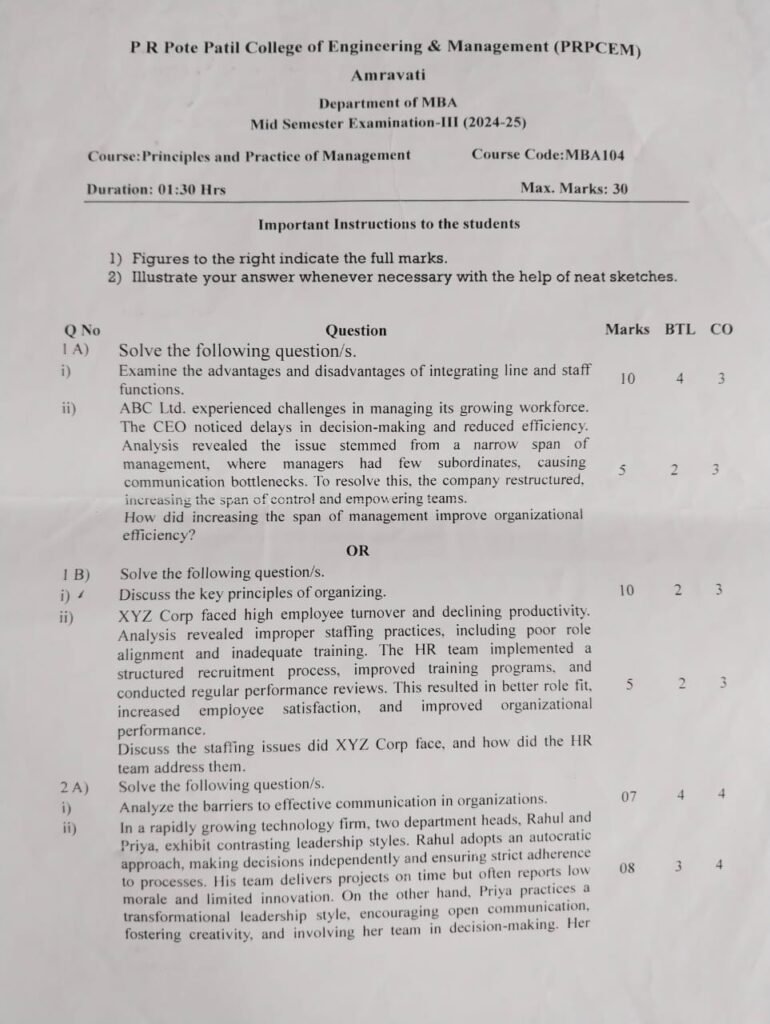
Q1 i) Examine the advantages and disadvantages of integrating line and staff functions.
In an organization, line authority means the power to give direct commands and make decisions related to core operations like production, sales, or service. Staff authority supports line managers by giving advice, expert suggestions, and technical guidance like HR, legal, R&D, finance etc. When both work together in an integrated system, performance becomes effective, but if coordination is weak, conflicts may arise.
Advantages:
First, integration leads to better decision-making. Line managers understand ground realities, while staff departments provide analytical reports and expert knowledge. When both combine, decisions become practical and well-informed. Second, integration reduces workload on line managers. Staff team handles reports, training, planning, compliance work, allowing line managers to focus on daily operations. Third, it increases innovation and long-term growth. Staff brings research, new tools and modern methods benefiting the whole organization. Example: In a manufacturing unit, production manager (line) and quality analyst (staff) work together to reduce defects.
Disadvantages:
Sometimes conflicts occur because line managers want quick execution, while staff may take time for data analysis. Staff may also feel their suggestions are ignored, while line managers may feel staff interferes without understanding ground issues. It may increase cost due to extra specialists. Communication gap between both also delays decisions.
Conclusion:
Integration of line and staff works best when roles are clearly defined, regular meetings are held, and mutual respect is maintained. If coordination is strong, organization benefits through better decisions and improved efficiency. If not managed properly, misunderstandings and delays may happen. Therefore, proper communication and authority clarity is important for smooth functioning.
Q1 ii) ABC Ltd. faced decision delays due to narrow span of management. How did increasing span improve efficiency?
A narrow span of management means one manager supervises very few employees. Although it allows close supervision, it increases number of managerial levels, slows communication, and causes delays in decision-making. In ABC Ltd., managers had very few subordinates, which created many layers. Information moved slowly from top to bottom and decisions took long time to reach employees. This affected productivity and work coordination.
When the span of management was increased, more employees started reporting directly to each manager, reducing hierarchy levels. This resulted in faster communication and quicker decision-making. Managers became more responsible and employees got more freedom. A wide span suits organizations where employees are skilled and routine tasks are standardized. ABC Ltd. restructured team allocation, gave more autonomy to middle managers and encouraged empowerment.
Benefits observed:
• Communication flow became direct and fast.
• Less bureaucracy and paperwork increased work speed.
• Decision-making became flexible and quicker.
• Employees felt trusted and motivated due to empowerment.
• Meeting costs reduced as fewer supervisory levels existed.
Example: Earlier 1 manager handled 4 subordinates, now 1 manager handles 10. Instead of passing decisions through 3 levels, decisions are communicated once to the entire team. The company completed projects faster and reduced delays by 25%.
Conclusion:
Increasing span works best when employees are trained and jobs are routine. It improves productivity, lowers cost, and increases responsibility. However, if span becomes too wide, supervision reduces and mistakes may occur. Therefore, companies must maintain an optimal span based on skill levels and task nature.
📌 SECTION 1 (B)
Q1 i) Discuss the key principles of organizing.
Organizing is the process of identifying activities, grouping them, assigning authority and creating a structure so work is completed efficiently. Certain principles guide effective organizing.
1. Division of Work:
Work should be divided into smaller tasks so people become specialists. Example: In a hospital, surgery team, nursing team and billing team handle their own parts.
2. Unity of Command:
Each employee should report to only one boss to avoid confusion. If instructions come from two managers, conflicts occur.
3. Span of Control:
A manager should supervise a limited number of workers based on task complexity. Routine work → wide span; complex work → narrow span.
4. Scalar Chain:
A formal chain of command from top to bottom ensures communication flow. However, direct contact can be used during emergency (Gang Plank).
5. Delegation of Authority:
Managers should delegate authority along with responsibility. It builds confidence and leadership in employees.
6. Balance of Authority and Responsibility:
Both must be equal. If authority is more and responsibility less → misuse of power. If reverse → inefficiency and stress.
7. Flexibility:
Structure must adapt to environmental change. Example: During festive sale, stores appoint temporary staff.
8. Efficiency and Simplicity:
Organization should not be too complicated. Simple structure saves time and reduces confusion.
Conclusion:
Organizing is necessary for smooth workflow. If these principles are followed, work becomes faster, accountability increases and teams coordinate better. Poor organizing leads to duplication of work and delays.
Q1 ii) XYZ Corp faced staffing issues. What were they and how HR solved them?
XYZ Corp experienced high turnover and low productivity mainly due to poor staffing practices, unclear role allocation, and lack of employee development. Employees were unsure of job expectations which created confusion and dissatisfaction. Training programs were insufficient, resulting in skill gaps and poor performance. Recruitment process was weak and not structured properly, leading to wrong job-person fit.
The HR department identified the problem and redesigned the staffing process. They first conducted job analysis to clearly define roles and responsibilities. Then they modified the recruitment process by screening candidates based on skill requirements. Regular performance reviews were added to monitor progress and give feedback. HR started training programs to improve employee capabilities and introduced development workshops to prepare employees for higher responsibilities.
Recognition and reward system was added to motivate employees. Employees with good performance were appreciated publicly which increased morale and work interest. This increased role clarity, job satisfaction and reduced conflict. Over time, productivity improved and employee turnover decreased.
Example: Earlier employees didn’t know expectations clearly, after restructuring, a sales executive received sales target, training on product knowledge and was reviewed monthly. He knew what to do and how to perform better.
Conclusion:
Staffing is successful only when right person is selected for right job and trained properly. XYZ Corp improved staffing by proper hiring, training, role clarity and performance appraisal. As a result, employees felt more secure, motivated and organizational efficiency increased.
📌 SECTION 2 (A)
Q1 i) Analyze barriers to effective communication in organizations.
Communication is effective when the message is sent clearly, received properly and understood correctly. However, organizations face many barriers.
1. Language Barriers:
Different understanding of words or technical terms may cause confusion. Example: Using jargon with new employees.
2. Filtering:
When message is modified intentionally or unintentionally while passing through layers of hierarchy.
3. Emotional Barriers:
Anger, stress or personal bias may distort communication. A frustrated employee may ignore instructions.
4. Information Overload:
Too much information at a time reduces understanding.
5. Poor Listening:
Communication fails when listener is distracted or not attentive.
6. Status & Cultural Barriers:
Employees hesitate to communicate freely with higher authority due to fear.
7. Physical Barriers:
Noise, long distance teams, poor internet/technology affect clarity.
How to overcome?
• Use simple language
• Encourage feedback
• Use formal + informal communication channels
• Reduce hierarchical layers
• Promote open and respectful culture
• Conduct communication skill training
Example: If an employee misunderstands order because of noise in production area, using written SOP or email removes confusion.
Conclusion:
Communication is the backbone of management. Identifying and removing barriers ensures better teamwork, decision-making and employee satisfaction.
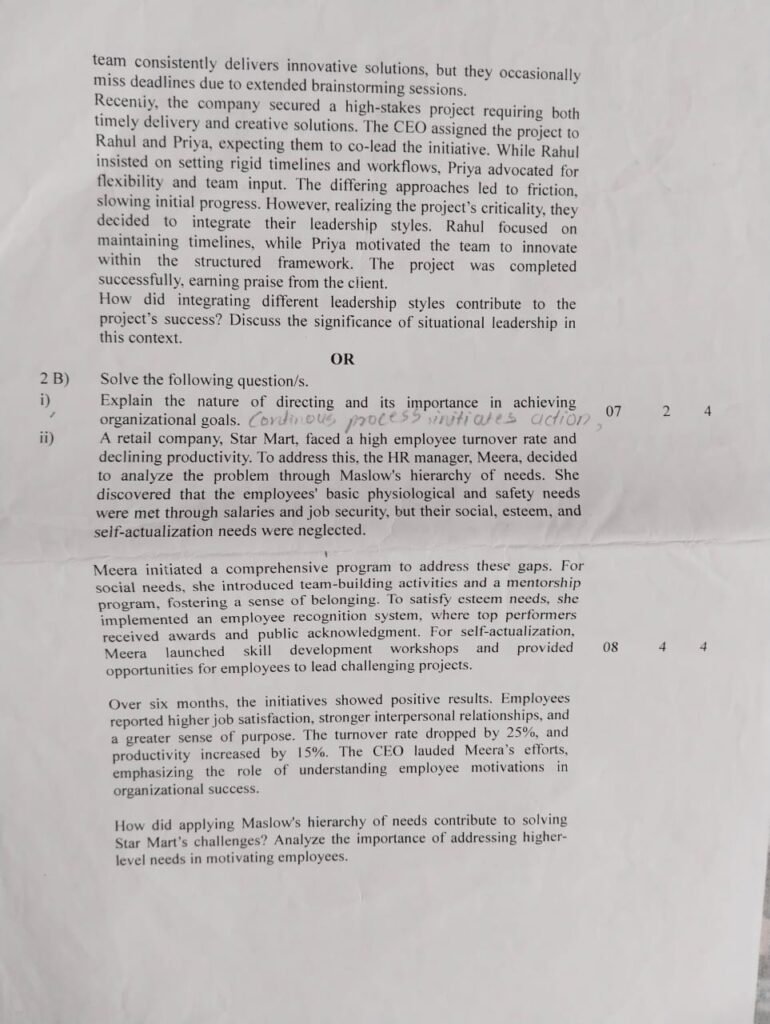
Q1 ii) Rahul autocratic vs Priya transformational leadership – analyze. (300 words)
Rahul followed an autocratic leadership style, where decisions are centralized and instructions are strictly followed. He emphasized deadlines and structured workflow. This style ensures discipline and speedy decisions but limits creativity and employee involvement.
Priya used transformational (democratic + inspirational) leadership, encouraging open communication, new ideas and team participation. She motivated team emotionally and developed trust. This improved innovation but sometimes delayed work due to lengthy discussions.
When project required both creativity + timely delivery, they merged their styles. Rahul ensured task discipline and goal timelines while Priya encouraged creativity and participation. Together they achieved efficiency with innovation. This is an example of situational leadership, where leader adjusts style based on work situation.
Example: Rahul controlled workflow and avoided delays, while Priya encouraged brainstorming sessions leading to creative solutions. By balancing structure and flexibility, project was completed successfully and client appreciated outcome.
Conclusion:
Both leadership styles are useful depending on situation. Autocratic suits urgent tasks and inexperienced teams. Transformational suits projects requiring creativity and employee involvement. The key is to combine styles according to needs.
📌 SECTION 2 (B)
Q1 i) Explain directing & its importance in achieving organizational goals. (300 words)
Directing means guiding, supervising, motivating and leading employees to work effectively for goals. It converts plans into action.
Importance:
• Initiates Action: Without direction, plans remain on paper.
• Motivates Employees: Through encouragement, recognition and rewards.
• Ensures Coordination: Harmonizes efforts between departments.
• Maintains Discipline: Clear instructions reduce errors.
• Enhances Productivity: Right guidance = faster work.
Elements of directing include leadership, communication, motivation and supervision.
Example: In a bank, manager explains monthly targets, gives training on loan products, motivates with incentives and monitors performance weekly. This ensures goal achievement.
Conclusion: Directing is essential for execution. It connects planning with performance. A well-directed workforce delivers results consistently.
Q1 ii) Maslow’s hierarchy application in Star Mart case. (300 words)
Star Mart faced high turnover and low productivity because employees basic needs were met (salary, security) but higher-level needs like belongingness, esteem and self-actualization were ignored. The HR manager used Maslow’s theory to improve conditions.
- Physiological & Safety Needs: Already satisfied with salary & safe environment.
- Social Needs: Team-building and mentorship increased bonding → sense of belongingness.
- Esteem Needs: Recognition programs, awards and appreciation boosted confidence.
- Self-Actualization: Skill development workshops, leadership opportunities enabled employees to grow.
Result: Satisfaction improved, turnover decreased, productivity increased 15%. When employees feel valued at higher levels, they stay motivated and committed.
Conclusion: Meeting only basic needs is not enough. Motivation increases when esteem and growth needs are fulfilled. Maslow’s theory guides HR to design policies for long-term employee engagement.