1 A (i)
What is the difference between fixed and variable costs in the context of production?
In production, total cost is made up of fixed cost and variable cost. Fixed cost is the cost which does not change with the level of output, at least in the short run. It has to be paid even if the firm produces nothing. Typical examples are factory rent, supervisor’s salary, insurance, depreciation of machinery, licence fees etc. Whether the firm produces 0 units or 10,000 units, these costs remain more or less constant. Therefore the fixed cost curve is a horizontal line when shown against output. Fixed cost per unit, however, falls as output increases because the same total fixed cost is spread over more units.
Variable cost is the cost which changes directly with the level of output. If output increases, variable cost increases; if output falls, variable cost also falls. Examples are cost of raw materials, power and fuel, packing material, wages of casual labour, commission on sales etc. When no output is produced, variable cost is zero. As production expands, more units of inputs are required, so variable cost rises. The variable cost curve starts from the origin and slopes upward.
So the basic difference is: fixed costs are output-independent in total, whereas variable costs are output-dependent. In the short run, management cannot easily change fixed costs, but it can control variable costs by changing the level of production. For decision making, managers are more concerned about variable cost and marginal cost for output decisions, while fixed cost is important for calculating break-even point and profitability. Together, both types of costs help the producer in deciding the optimum level of output and pricing policy.
1 A (ii)
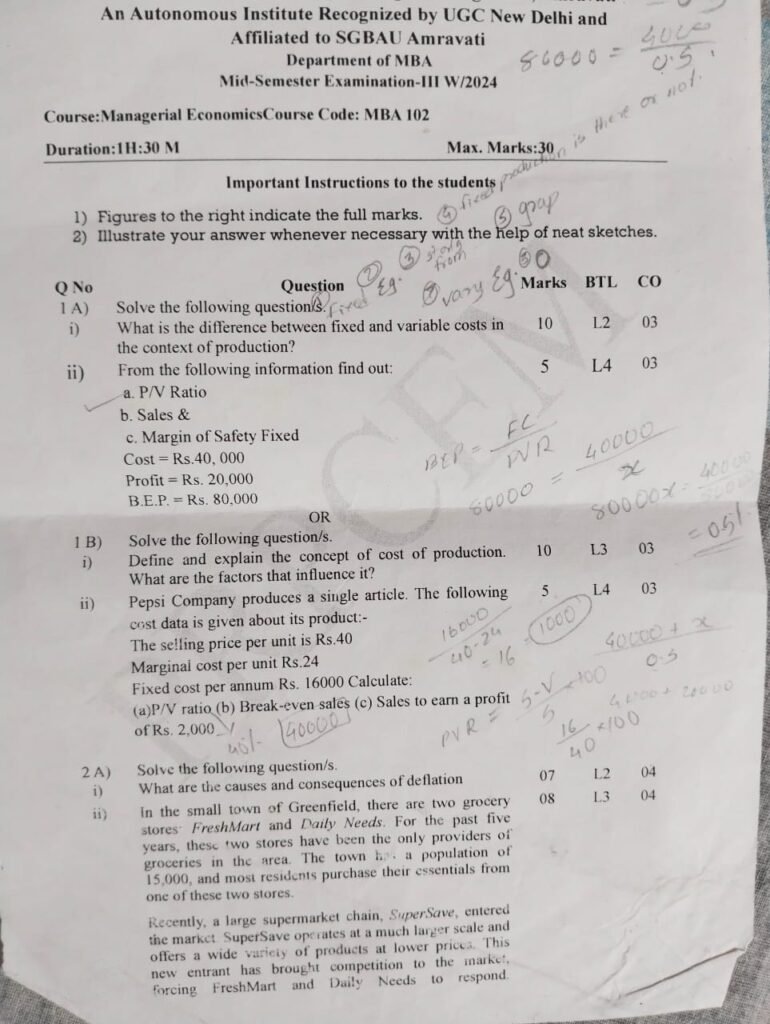
From the following information find out: (a) P/V Ratio (b) Sales (c) Margin of Safety
- Fixed Cost (FC) = ₹40,000
- Profit = ₹20,000
- Break-Even Point (BEP) Sales = ₹80,000
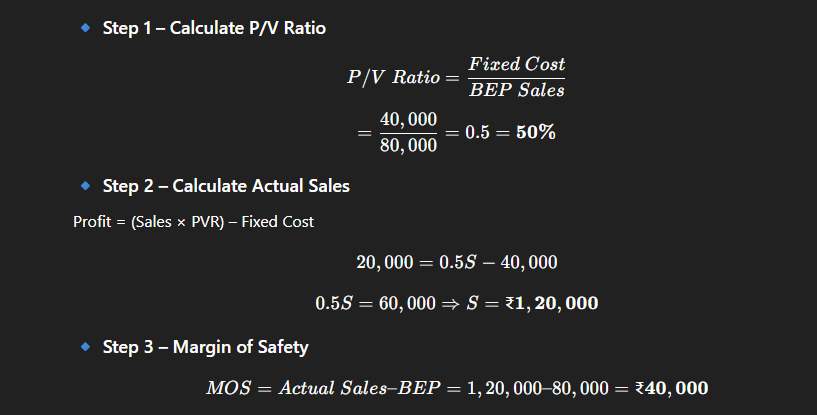
Answer:
P/V Ratio = 50%
Sales = ₹1,20,000
Margin of Safety = ₹40,000 (or 33.33%)
1 B (i)
Define and explain the concept of cost of production. What are the factors that influence it?
Cost of production is the total expenditure incurred by a firm to produce and sell a given level of output. It includes all payments for the use of factors of production such as land, labour, capital and entrepreneurship, plus the cost of raw materials, power, fuel, transport, packing and other overheads. In economics we also include implicit costs (like interest on owner’s capital or rent of owner’s building) along with explicit costs actually paid in cash.
Cost of production is usually classified into fixed cost, variable cost and semi-variable cost. Fixed cost is paid irrespective of output, while variable cost changes with the volume of production. Together they form total cost; average and marginal costs are derived from them. For a business, understanding its cost of production per unit is very important, because it influences pricing decisions, profit margin, competitiveness in the market and break-even point.
Several factors influence cost of production. First is the price of inputs – wages of workers, cost of raw material, interest rate on borrowed funds, power tariffs etc. If any of these rise, cost per unit goes up. Second, technology and productivity matter a lot. Better machines, improved processes and skilled workers can increase output per unit of input, thereby reducing cost. Third, scale of production affects cost: due to economies of scale, large-scale production often brings down average cost; but beyond a point, diseconomies may increase cost. Fourth, management efficiency and organisation also influence cost – proper planning, minimisation of wastage, good inventory control and efficient utilisation of capacity help in cost reduction. Finally, government policies, such as taxes, regulations, subsidies and environmental norms, also affect the overall cost of production.
1 B (ii)
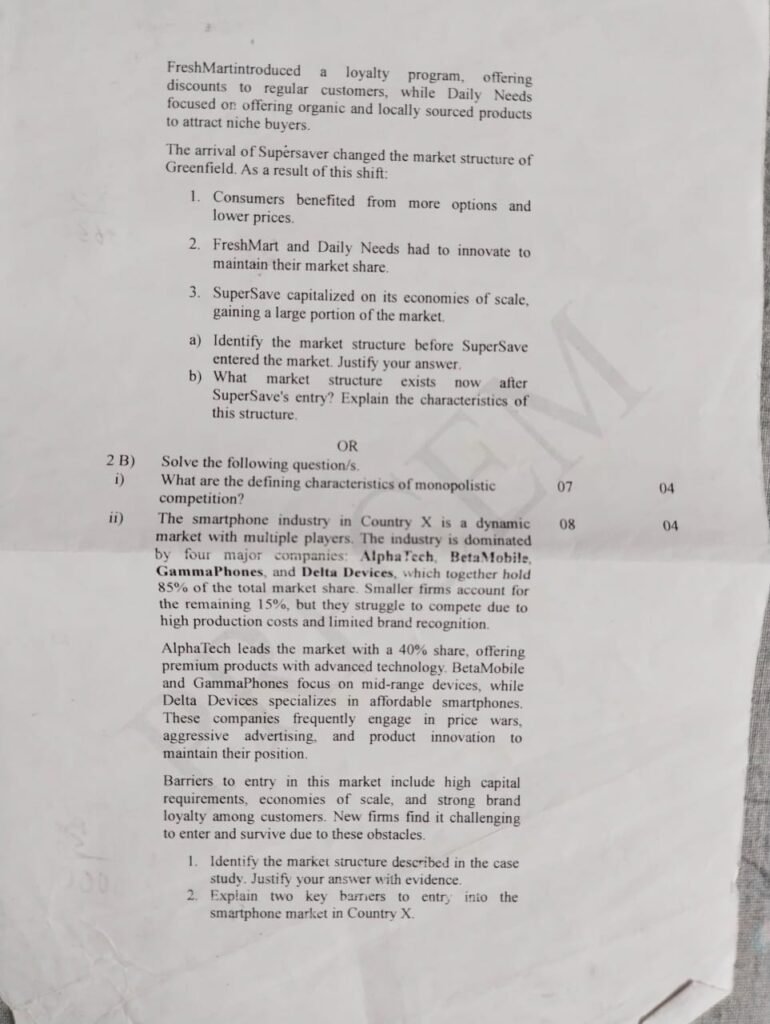
Pepsi Company – CVP Problem
Given:
- Selling price per unit (SP) = ₹40
- Marginal / Variable cost per unit (VC) = ₹24
- Fixed Cost (FC) per annum = ₹16,000
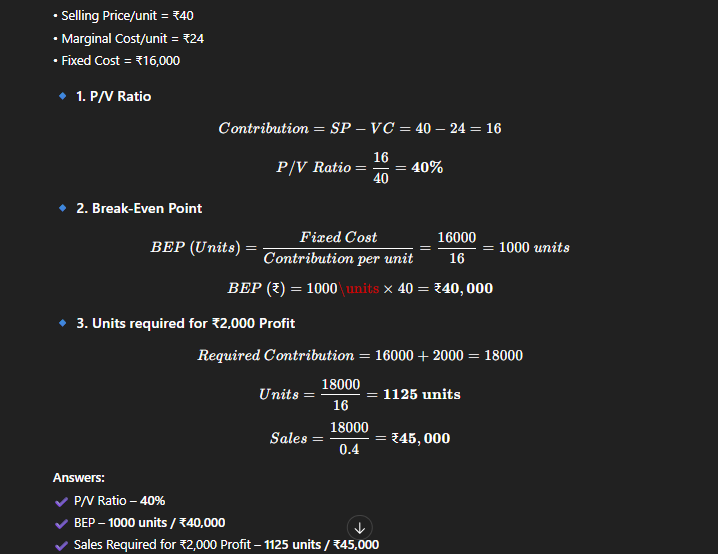
Answer:
P/V Ratio = 40%
Break-even = 1,000 units or ₹40,000
Sales to earn ₹2,000 profit = 1,125 units or ₹45,000
2 A (i)
What are the causes and consequences of deflation?
Deflation is a condition where general price level decreases continuously, reducing consumer spending and business profit. It is opposite to inflation. Small price drop looks good for buyers, but long-term deflation is dangerous for the economy.
Causes of Deflation:
- Fall in Aggregate Demand: When income reduces or unemployment increases, people buy less.
- High Interest Rates: Loans become costly, reducing investment.
- Decrease in Consumption Confidence: People delay buying expecting lower future prices.
- Overproduction: Supply becomes higher than demand.
- Reduction in Government Expenditure.
Consequences of Deflation:
Deflation increases the real value of money, so people hold money instead of spending. Businesses earn less revenue, leading to layoffs. Unemployment increases which reduces demand further and forms a deflationary spiral. Firms stop expansion plans, investors lose confidence, and stock markets fall.
Example: If a TV price drops from ₹30,000 to ₹27,000 next month, buyers postpone purchase. Sellers reduce prices further, decreasing profit. Workers are fired to reduce cost. Purchasing power reduces and the economy slows down.
Deflation looks beneficial initially but harms long-term growth, production and income. To control deflation, government uses expansionary monetary policy (lower interest rate) and fiscal measures like increasing public spending.
2 A (ii) – Greenfield Case
(a) Market structure before SuperSave entered. (b) Market structure after entry and its characteristics.
Before SuperSave entered, the town of Greenfield had only two grocery stores – FreshMart and Daily Needs – serving the entire population of 15,000. They were the only providers of groceries for five years. This situation, where two firms dominate the market for a homogeneous product, is called a duopoly, which is a special case of oligopoly. Each store would have been aware that any change in its price or service could affect the other’s sales. Entry of new firms was absent, and customers had to choose between only these two options. So the earlier market structure can be described as a duopoly with limited competition.
After SuperSave’s entry, the structure changes significantly. Now there are three major players, with SuperSave operating on a much larger scale and offering a wide variety of products at lower prices. This creates an oligopolistic market structure in Greenfield. Key characteristics of oligopoly seen in the case are:
- Few large sellers – FreshMart, Daily Needs and SuperSave dominate the grocery market.
- Interdependence – The actions of one firm affect others. When SuperSave cut prices, the existing stores had to react by introducing loyalty programs and product differentiation.
- Product differentiation and non-price competition – FreshMart uses loyalty discounts, Daily Needs focuses on organic and local products, and SuperSave uses variety and economies of scale.
- Economies of scale – SuperSave’s large-scale operations allow it to offer lower prices and capture a major part of the market.
Thus, after the entry of SuperSave, Greenfield’s grocery market clearly exhibits the features of an oligopoly with active competition and strategic behaviour among a few big firms.
2 B (i)
What are the defining characteristics of monopolistic competition?
Monopolistic competition is a market structure that combines features of both perfect competition and monopoly. It is very common in real life, especially in markets for branded consumer goods like restaurants, clothing, cosmetics and mobile apps.
The first key characteristic is the presence of many sellers and many buyers. No single firm controls the entire market; each one has a relatively small share. However, unlike perfect competition, each firm sells a differentiated product. Products are close substitutes but not identical – they differ in brand name, quality, design, packaging, features or services. For example, different shampoos, toothpastes or fast-food outlets.
Because of product differentiation, each firm faces a downward-sloping demand curve and enjoys some degree of monopoly power over its own brand. This allows the firm to charge a slightly higher price than rivals. At the same time, the presence of close substitutes keeps this power limited – if a firm raises price too much, consumers can easily switch to another brand.
Another important feature is freedom of entry and exit. New firms can enter the market if existing firms earn abnormal profits, and they can leave when profits fall. In the short run, firms may earn supernormal profits or incur losses. But in the long run, free entry and exit drive economic profits towards normal profit only. Firms operate with some excess capacity, meaning they do not produce at minimum average cost.
Non-price competition is very strong in monopolistic competition. Firms spend heavily on advertising, branding, packaging, promotions, after-sales service and product innovation to attract customers. Selling costs are a major part of total cost. Finally, there is independent decision-making: each firm decides its own price and output policy, although it remains aware of rivals. Overall, monopolistic competition is the most realistic representation of many modern consumer markets.
2 B (ii) – Smartphone Market Case
1. Identify the market structure. 2. Explain two key barriers to entry.
The smartphone industry in Country X is described as having four major companies – AlphaTech, BetaMobile, GammaPhones and Delta Devices – jointly holding 85% of the market, while smaller firms share only 15% and face difficulty in competing. These big firms engage in price wars, aggressive advertising and product innovation. There are also significant barriers to entry such as high capital requirements, economies of scale and strong brand loyalty. This combination of few dominant sellers, product differentiation, strategic behaviour and entry barriers fits the definition of an oligopoly. In an oligopolistic market, a small number of large firms control most of the output, are interdependent in their decisions, and use both price and non-price competition to maintain market share. The case clearly matches these features.
Two key barriers to entry in this smartphone market are:
(a) High capital requirements and economies of scale.
Producing smartphones requires huge investment in R&D, advanced manufacturing plants, distribution networks and software ecosystems. Existing large firms like AlphaTech already operate on a massive scale, so their average cost per unit is low. A new entrant, starting with small output, cannot match these costs. Without similar economies of scale, it will either have to charge higher prices or accept lower profit margins. This discourages new firms from entering.
(b) Strong brand loyalty and marketing power.
The leading companies have built powerful brands through years of advertising, high product quality and customer service. Consumers trust these brands and are often emotionally attached to them. Switching to a new, unknown brand involves risk in terms of quality, reliability and resale value. To break this loyalty, a new firm would need massive advertising and promotional expenditure, which again requires large financial resources. Hence, brand loyalty acts as a strong psychological and financial barrier to entry.
Together, these barriers protect existing oligopolistic firms and make entry and survival of new competitors very difficult.