📍 Q1 A (i)
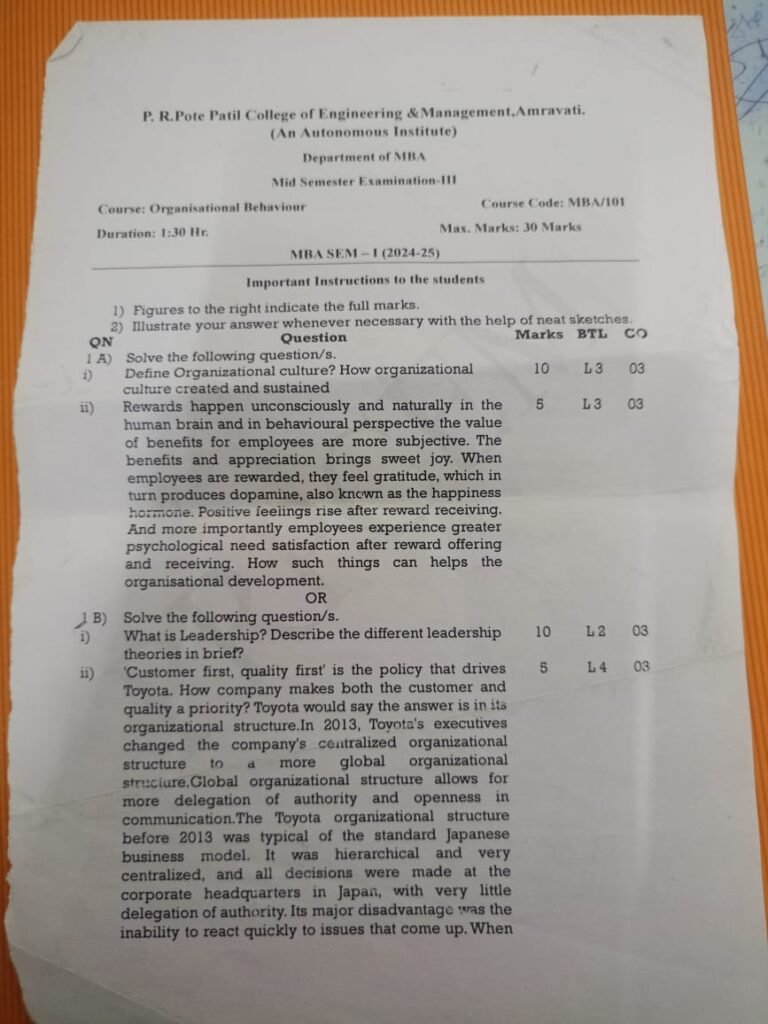
Define Organisational Culture. How organisational culture is created and sustained?
Organisational culture means the shared values, beliefs, behaviours and work practices that employees follow inside the organisation. It is basically the personality of a company. It tells us how people communicate, how decisions are taken, how employees dress, and how customers are treated. Every organisation has its own culture—some are strict, formal and rule-based, while some are open, innovative and friendly. For example, Google focuses on creativity and flexible work, whereas the Army follows discipline and command-based working. A strong culture brings unity, motivation, teamwork and better performance.
How culture is created: Culture begins from the founder’s vision and values. The beliefs of founders become the base for everyone. Next step is hiring people who fit the culture. Socialisation process also plays a part; new employees learn how to behave by observing seniors. Leadership has the biggest influence because employees follow what leaders practice. Stories, rituals, office layout, code of conduct and training programs also help in building culture.
How culture is sustained: Culture continues through selection, leadership behaviour, and reward system. When employees follow cultural values, they get appreciation, promotion or recognition. This motivates others to follow the same. Regular communication through newsletters, events, meetings and traditions keeps culture alive. Over time, culture becomes a habit and identity of an organisation. In conclusion, organisational culture is created through founders and socialisation and sustained through leadership and rewards.
📍 Q1 A (ii)
Rewards happen unconsciously… How reward system helps organisational development?
Rewards are something given to employees when they perform well. Rewards may be money, appreciation, promotion or even praise. In the human brain, receiving rewards releases dopamine, also called the happiness chemical. When employees feel valued, their motivation increases automatically without force. Rewards make people feel respected and recognised for their efforts. This improves job satisfaction, confidence and emotional connection with the organisation.
There are two types of rewards—monetary and non-monetary. Monetary rewards include salary increment, bonus, incentives etc. Non-monetary rewards include certificate, appreciation, training opportunity, flexible work hours, best employee award and recognition. Many employees prefer non-monetary rewards because they feel emotionally valued. When employees are rewarded, they work harder and show more loyalty.
Reward system helps the organisation in many ways. It increases productivity as employees try to achieve better results. It reduces absenteeism and turnover because satisfied employees do not leave easily. Rewards create a positive work environment and encourage healthy competition among employees. It also helps in achieving organisational goals faster because motivated employees give extra effort.
Reward system also strengthens organisational culture. When an employee is rewarded for discipline, others also follow discipline. When teamwork gets rewarded, cooperation increases. In this way, reward mechanism indirectly shapes behaviour. A fair reward system builds trust between workers and management. In the long run, rewards improve performance, creativity, innovation and support organisational development.
📍 Q1 B (i)
What is Leadership? Describe the different leadership theories in brief.
Leadership means the ability to influence, guide and motivate people to achieve goals. A leader is someone who inspires others to work willingly, not by force. Leadership builds confidence, team spirit and direction inside organisation.
Leadership theories in brief:
- Trait Theory – States leaders are born with qualities like confidence, intelligence, honesty and communication. Example: natural leaders like Gandhi.
- Behavioural Theory – Leadership depends on behaviour, not born qualities. Two main styles:
• Consideration (people-oriented)
• Initiating structure (task-oriented) - Contingency/Fiedler Theory – No single leadership style is best. Leadership effectiveness depends on situation, leader-member relation, task structure and authority level.
- Situational Theory (Hersey-Blanchard) – Leadership style must change according to maturity of followers. Styles: telling, selling, participating, delegating.
- Path-Goal Theory (House) – Leader guides employees towards goal by using styles like directive, supportive, participative and achievement-oriented.
- Transactional vs Transformational Theory –
• Transactional: reward and punishment based.
• Transformational: inspires and changes mindset for long-term vision.
Leadership is necessary to manage teams, reduce conflicts and achieve goals effectively.
📍 Q1 B (ii)
Analyse Toyota case: How company makes customer and quality a priority?
Toyota follows the policy “Customer first, Quality first”, which means customer satisfaction is their top priority. Toyota focuses on quality at every production stage. They use continuous improvement method called Kaizen, where small improvements are done every day. Toyota also follows Just-in-Time (JIT) which reduces waste and increases efficiency.
Toyota shifted from highly centralised structure to decentralised structure. Earlier decisions were slow because only top management had authority. After restructuring, decision-making power was shared with lower-level managers. This increased flexibility and quick response to quality issues. When quality problems arise, they don’t wait for long approvals; team immediately solves it.
Toyota collects customer feedback, reviews complaints and modifies design based on customer needs. They believe customer satisfaction brings long-term profit more than short-term sales. Toyota values employee training for quality control. Employees are empowered to stop production if a defect is found (Andon system). This prevents faulty cars from reaching customers.
Because of quality control, Toyota gained brand trust worldwide. Their cars last long, give good performance and safety. Due to customer focus, Toyota competes strongly with global brands. Customer priority + decentralised decision-making + continuous improvement = successful organisational growth.
📍 Q2 A (i)
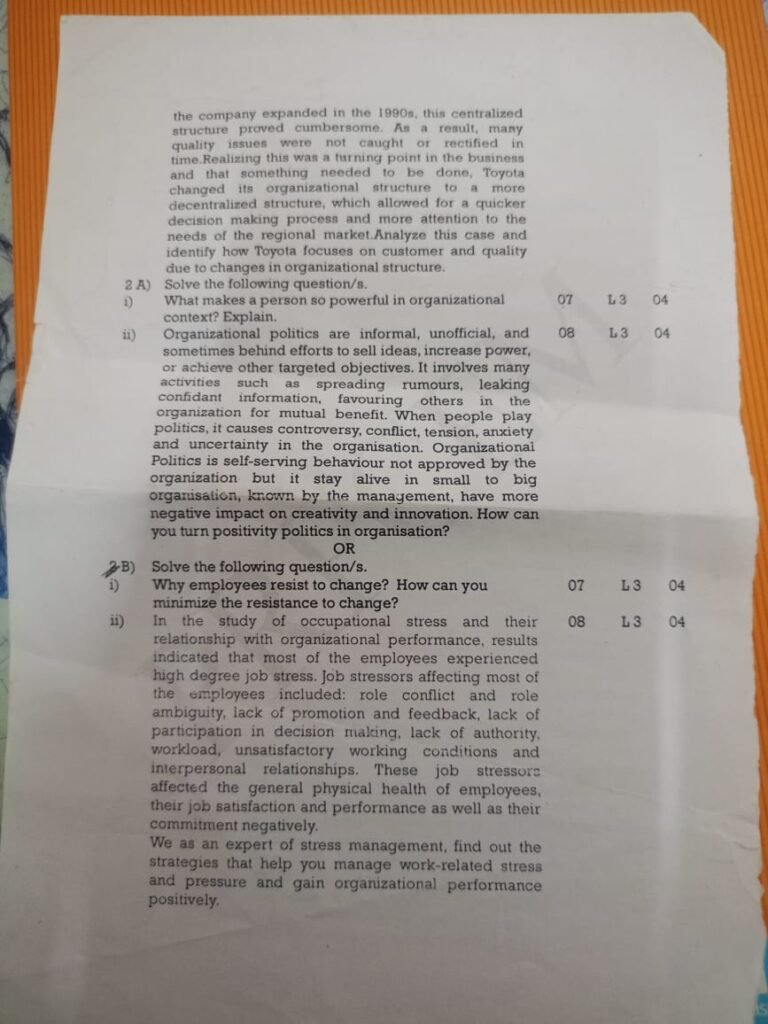
What makes a person powerful in an organisation? Explain.
A person becomes powerful based on ability to influence others, control resources and take decisions. Power is not only in position but also in personality and knowledge. In an organisation, power comes from several sources.
- Position Power – Managers have authority to assign tasks, evaluate performance and give rewards. Higher the position, greater the power.
- Expert Power – Employees with special skills or knowledge become powerful. Example: IT expert in company becomes important even if not manager.
- Reward Power – Power to give promotion, bonus and recognition. Employees tend to follow those who control rewards.
- Coercive Power – Ability to punish or take strict action. Leaders use it to maintain discipline but overuse can create fear.
- Referent Power – Comes from personality, charm and respect. People follow because they admire the leader. Example: friendly manager liked by everyone.
- Information Power – Those who hold confidential or important data become powerful. Example: HR, finance officer.
A person becomes powerful when they show communication skills, confidence, problem solving, good relationships and trust-building. Power is effective when used positively for development of team, not for ego. True power is earned through behaviour, not only given by designation.
📍 Q2 A (ii)
Organisational politics… How can we turn politics into positive politics?
Organisational politics means using unofficial methods to influence decisions, gain power or achieve personal goals. It includes gossip, rumours, favoritism and backdoor influence. Negative politics creates stress, conflict, tension, distrust and reduces innovation. It wastes employee time in manipulation rather than productivity.
But politics is not always bad. If used ethically, it becomes positive politics which supports organisational growth. To convert politics into positive behaviour, first transparency is needed. Clear communication reduces misunderstanding. Managers should encourage open feedback so employees share issues directly instead of gossiping. Rewarding honesty and performance instead of favoritism builds trust.
Employees should focus on collaboration rather than jealousy. Teams must share credit when project succeeds. Leadership plays key role. Leaders must act fair, unbiased and treat everyone equally. Training on ethics develops moral behaviour. Healthy competition, employee involvement in decision making and conflict resolution methods reduce negative politics.
Positive politics looks like influencing decisions for organisation benefit, not self benefit. For example, convincing management for employee development program is positive influence. When politics is used to improve coordination, solve problems and take initiative, it becomes productive. So instead of removing politics completely, we must guide it towards creativity, fairness and growth.
📍 Q2 B (i)
Why employees resist change? How to minimize resistance?
Employees resist change because they fear losing comfort, routine or job security. Humans are habitual to patterns. New methods feel risky and uncomfortable. Reasons for resistance include fear of unknown, lack of information, poor communication, no participation in decisions, workload increase and lack of trust in management. Some resist because they believe change may reduce power, status or benefits. Example: workers fear automation may replace jobs.
To reduce resistance, communication must be clear. Management should explain why change is needed and how it benefits employees. Training programs help employees learn new skills. Participation reduces fear—when people are involved in planning, they support change. Leaders should provide support and counseling to reduce stress. Incentives, appreciation and recognition help employees accept change faster.
Short-term wins must be shown to employees so they believe change is useful. Flexibility, patience and feedback are necessary. Change becomes easy when company builds culture of learning and innovation. In simple words, resistance comes from fear, and solution comes from support.
📍 Q2 B (ii)
As a stress management expert, suggest strategies to manage work stress and improve performance.
Work stress arises due to workload, deadlines, role conflict, low salary, lack of promotion, interpersonal issues etc. Stress reduces employee health, motivation and concentration. To manage stress, first identify its cause. Proper time management can reduce workload pressure. Employees should prioritize tasks using to-do lists.
Breaks between work refresh mind. Simple breathing exercises and meditation reduce anxiety. Organisations must provide recreational activities, flexible timing, fair workload distribution, training and career growth. Supportive leadership reduces pressure. Friendly work environment encourages employees to share problems.
Physical activities like walking, sports and stretching decrease tension. Healthy diet, sleep and hydration boost energy. Setting realistic goals avoids burnout. Rewarding good work increases motivation. Sharing tasks among team members reduces pressure on one person. If stress becomes high, counseling or therapy may help.
Stress management leads to higher productivity, job satisfaction and organisational performance.